
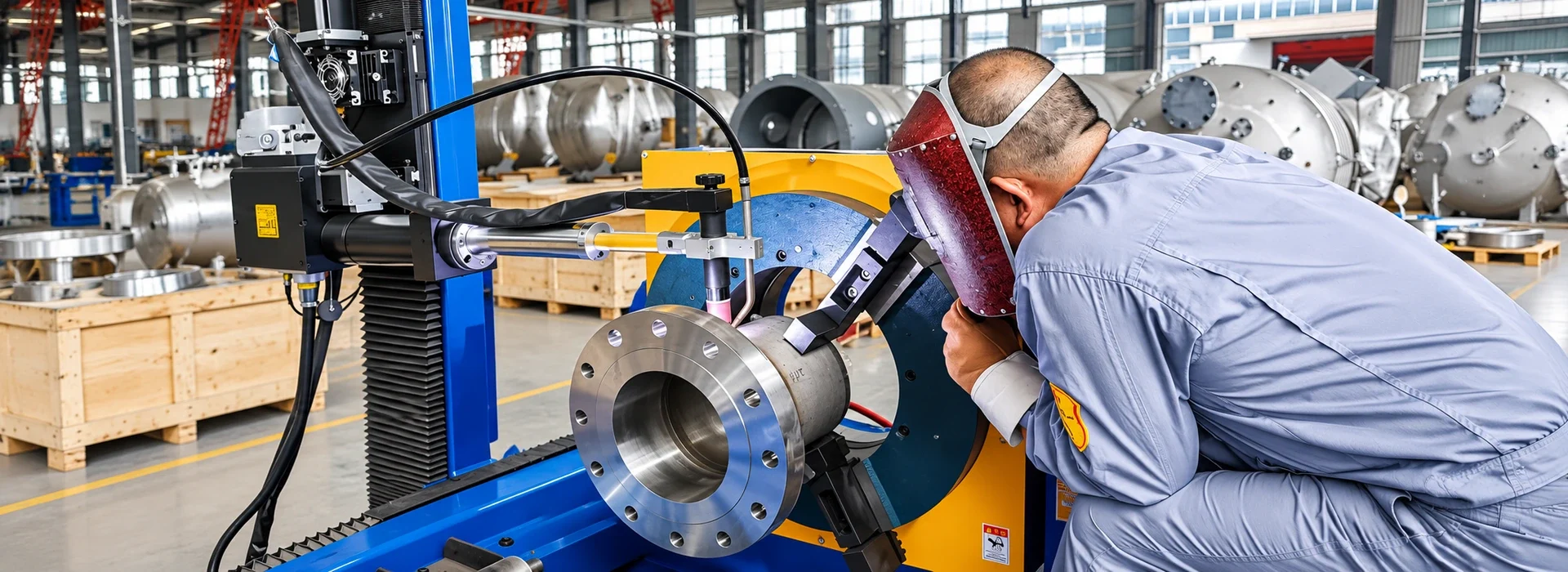
In pipe fabrication, welding automation can improve productivity, increase weld consistency, and reduce reliance on highly skilled manual welders.
However, when manufacturers evaluate automated pipe welding solutions, one important question often arises: Should you invest in an industrial welding robot or a dedicated pipe welding system?
Both technologies have proven applications, but they differ in design philosophy, operating requirements, and return on investment. Robotic pipe welding offers multi-axis motion and flexible control of complex welding paths. Dedicated pipe welding systems, on the other hand, are designed around specific workpieces, joint configurations, welding processes, and production requirements.
For manufacturers involved in pipe fabrication, pressure piping, hydraulic tube assemblies, and other industrial piping components, the most important question is not which technology is more advanced. It is which solution best fits your workpieces, welding processes, and production requirements.
This article compares robotic pipe welding and dedicated pipe welding systems in terms of welding position, wire feeding, weld quality, production flexibility, and practical application.
Robotic vs. Dedicated Pipe Welding: Quick Comparison
| Comparison | Industrial Robots | Dedicated Pipe Welding Systems |
|---|---|---|
| Welding Motion | Multi-axis torch movement | Controlled workpiece rotation or specialized motion |
| Best Suited For | Complex weld paths and multiple orientations | Repetitive circumferential pipe welds |
| Wire Feeding | Requires careful routing and integration | More consistent feeding geometry in fixed-torch setups |
| Product Changeover | May require program and fixture adjustments | Often uses adjustable clamps and stored programs |
| Weld Quality | Depends on process validation and integration | Depends on process validation and stable operating conditions |
| Investment | Depends on robot, tooling and integration | Depends on machine configuration and automation level |
1. Welding Position and Process Stability
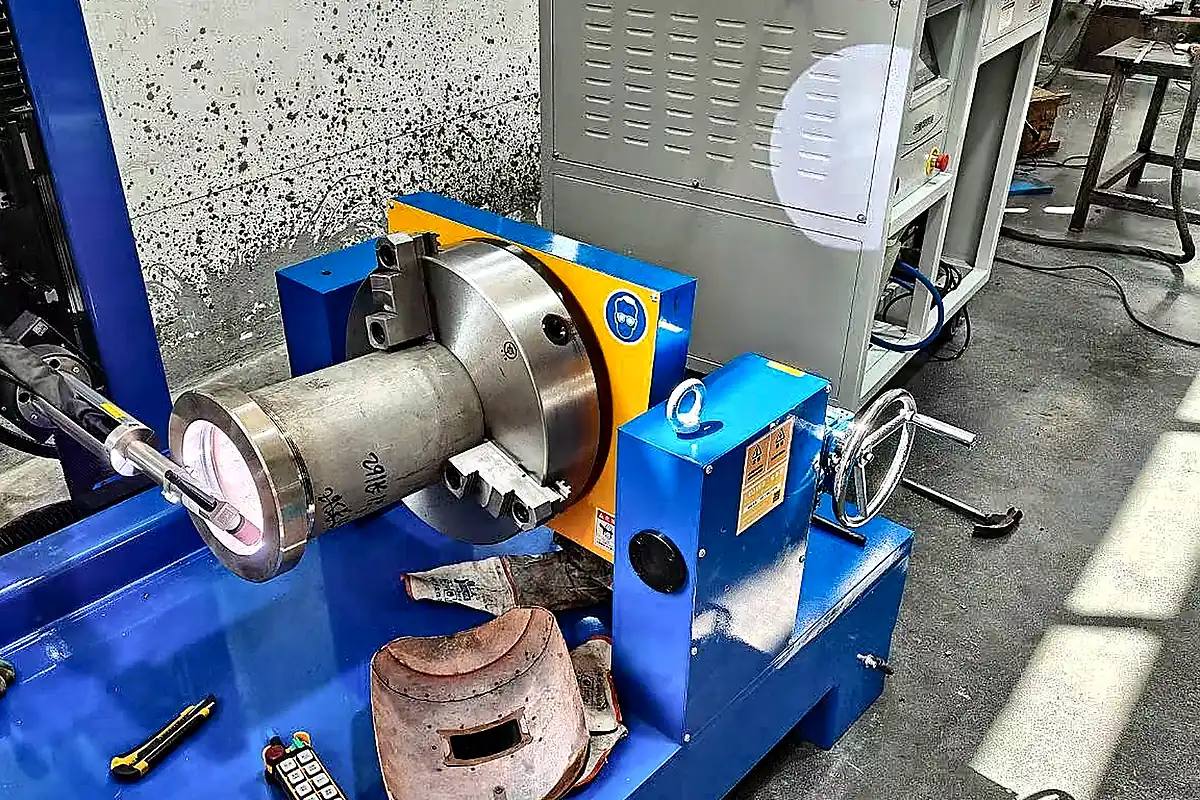
Rotary pipe welding positioner securing a cylindrical workpiece for circumferential welding.
Welding stability depends on more than the welding power source and parameter settings. Welding position, molten pool behavior, torch orientation, filler wire delivery, and workpiece fit-up all influence the final result.
In TIG pipe welding, particularly during root-pass welding, precise control of the molten pool, filler wire position, and penetration is essential.
Dedicated Pipe Welding Systems: Optimized for Consistent Welding Conditions
In a typical workpiece-rotating pipe welding system, the pipe rotates while the welding torch remains in a relatively fixed position.
This arrangement helps maintain consistent torch orientation, filler wire delivery, and relative positioning between the torch and the weld joint. With properly matched rotation speed, welding parameters, and wire feeding, the system can maintain consistent welding conditions throughout production.
For circumferential pipe welds requiring reliable root penetration and full root-side formation, this configuration can offer significant advantages, particularly in TIG welding applications.
Different pipe diameters and wall thicknesses can also be accommodated through mechanical adjustments, clamping changes, and the selection of validated welding programs. This helps manufacturers establish repeatable welding procedures for different product specifications.
For manufacturers exploring workpiece-rotating TIG welding equipment, the MECANEXT H1440-T automatic TIG welding machine is one example of a system designed for circumferential welding of pipes, fittings, and cylindrical components.
Industrial Welding Robots: Greater Motion Flexibility, More Complex Integration
Industrial welding robots can precisely control torch position and travel paths across multiple axes. This makes them suitable for multi-directional welds and complex three-dimensional structures.
However, actual performance depends on the complete system configuration, including the wire feeding system, torch orientation, workpiece positioning, positioners, and welding programs.
For circumferential pipe welding, a robot may need to continuously adjust torch position and orientation if the workpiece remains stationary. Depending on the joint geometry and required welding position, this can increase the complexity of motion planning and welding procedure development.
A properly designed workpiece positioner can also help maintain favorable welding positions during robotic welding. Therefore, robots are fully capable of producing consistent pipe welds when the complete system is correctly engineered.
The key difference is that dedicated pipe welding systems generally simplify motion and stabilize process conditions, while industrial robots provide greater motion flexibility for more varied welding tasks.
The American Welding Society’s Certified Robotic Arc Welding program also emphasizes the importance of robotic programming, equipment setup, welding procedures, and weld examination. This highlights why successful robotic welding requires more than accurate robot motion alone.
2. Wire Feeding and Root-Pass Quality
According to TWI’s technical guidance on TIG welding, the process uses a non-consumable tungsten electrode, with filler metal added separately when required. These characteristics make precise torch positioning and filler wire control important considerations in automated pipe welding.
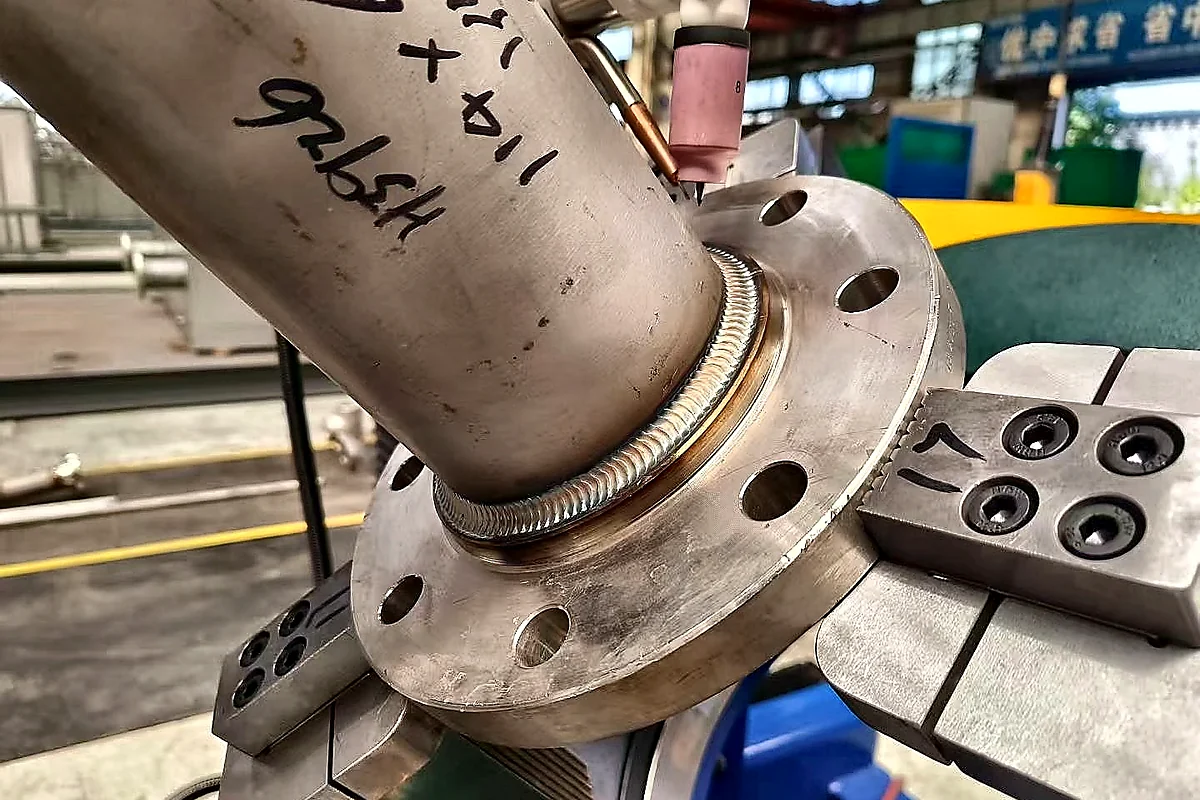
TIG welding setup showing torch positioning at a pipe-to-flange joint.
In TIG pipe welding, filler wire position, feed angle, and feed speed directly influence molten pool behavior and root-side weld formation.
These factors are particularly important when welding thin-wall pipes, working with small root gaps, or targeting full root penetration and consistent internal weld profiles.
The Advantages of Dedicated Welding Systems
Dedicated pipe welding systems typically use a relatively fixed torch arrangement and wire feeding path.
In a workpiece-rotating configuration, the torch and wire feeding mechanism do not need to follow complex multi-axis movements during the welding cycle.
This helps reduce variations associated with changes in wire feeding geometry and makes it easier to optimize the welding process for specific pipe diameters, wall thicknesses, and joint configurations.
For repetitive production, a stable mechanical arrangement combined with validated welding programs can improve process consistency and reduce variation between workpieces.
What Should You Consider with Robotic Welding?
In robotic welding applications, the wire feeding conduit may change its routing and bending radius as the robot arm moves. If the system is poorly arranged, this can increase wire feeding resistance and affect feeding stability, particularly at low wire feed speeds.
However, this is not an inherent limitation of industrial robots. Appropriate wire feeder positioning, conduit management, feeder selection, and robot motion planning can provide stable wire delivery.
When evaluating robotic pipe welding equipment, manufacturers should therefore assess the complete welding system rather than the robot alone.
The best approach is to conduct continuous welding trials using actual workpieces. Evaluate root-side formation, wire feeding behavior, and process consistency across the required welding positions instead of relying solely on demonstration videos.
For a closer look at rotary welding applications, see our guide to automated pipe-to-flange welding, covering fillet and butt joints, workpiece rotation, and practical welding considerations.
3. Weld Quality and Defect Control
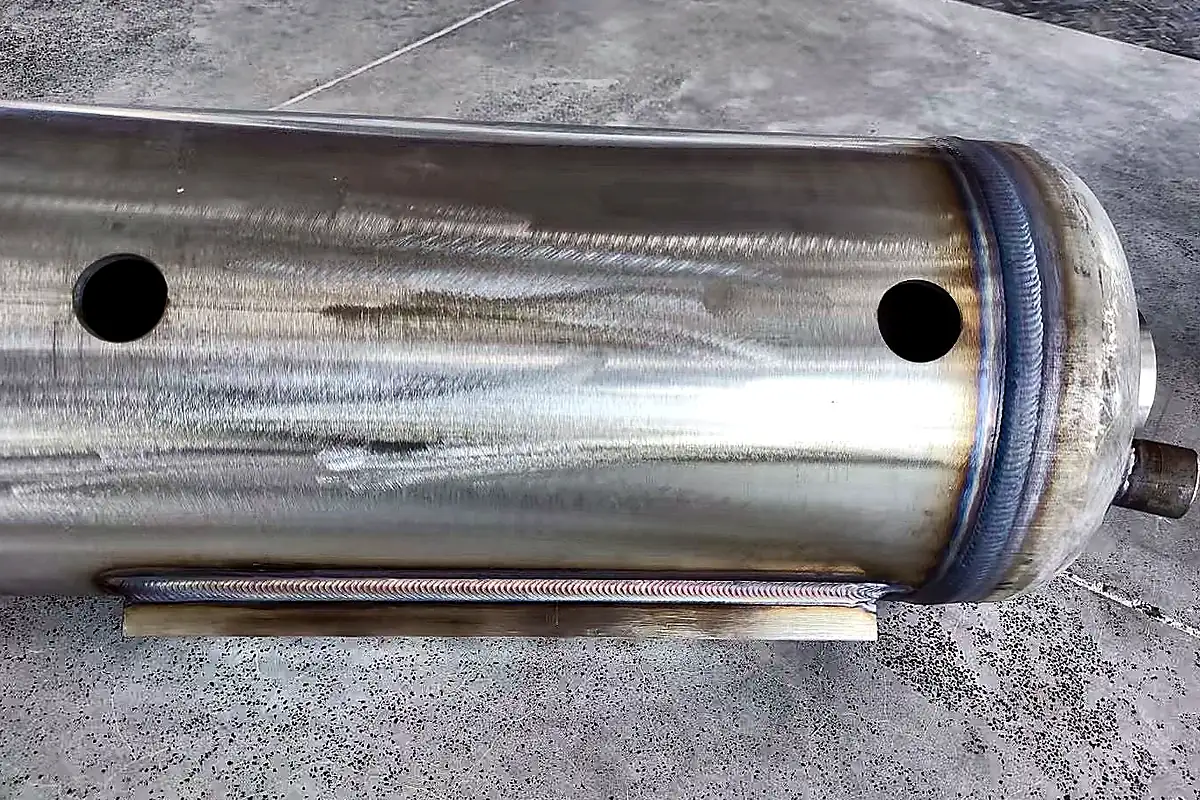
Close-up of a completed circumferential weld on a stainless steel pipe.
For pressure piping, industrial fluid systems, and other applications with demanding quality requirements, weld integrity is often more important than welding speed alone.
Defects such as porosity, lack of fusion, incomplete penetration, burn-through, undercut, and inconsistent root formation can lead to rework, production delays, and difficulties meeting inspection requirements.
Dedicated Welding Systems: Supporting Repeatable Production
When pipe dimensions and joint configurations are clearly defined and the welding procedure has been validated, a dedicated welding system can integrate rotation speed, welding current, wire feed speed, and other process parameters into standardized programs.
In a workpiece-rotating system, the torch can maintain a fixed orientation while the pipe rotates at a controlled speed. With an appropriate welding procedure, the circumferential weld can be produced under relatively consistent conditions.
This arrangement helps reduce process variation caused by changes in manual operation and makes it easier to establish repeatable production procedures.
Robotic Welding: Quality Depends on Process and System Integration
Industrial robots can accurately follow complex welding paths through coordinated multi-axis movement.
However, robotic pipe welding also requires careful consideration of workpiece positioning, groove geometry, root gap variation, torch accessibility, and molten pool behavior at different welding positions.
If dimensional deviations or fit-up variations exceed the qualified process window, accurately repeating a programmed path does not necessarily guarantee an acceptable weld.
Depending on the application, improvements may require more precise workpiece positioning, seam tracking, vision systems, or adaptive welding controls.
It is equally important to recognize that dedicated welding systems cannot automatically compensate for poor fit-up, incorrect parameters, or an unsuitable welding procedure.
For applications with strict inspection requirements, compare actual weld quality, inspection results, and repair rates from representative welding trials—not simply whether the equipment uses a robot or a dedicated mechanism.
4. Production Flexibility: Which Is Better for High-Mix, Low-Volume Pipe Fabrication?
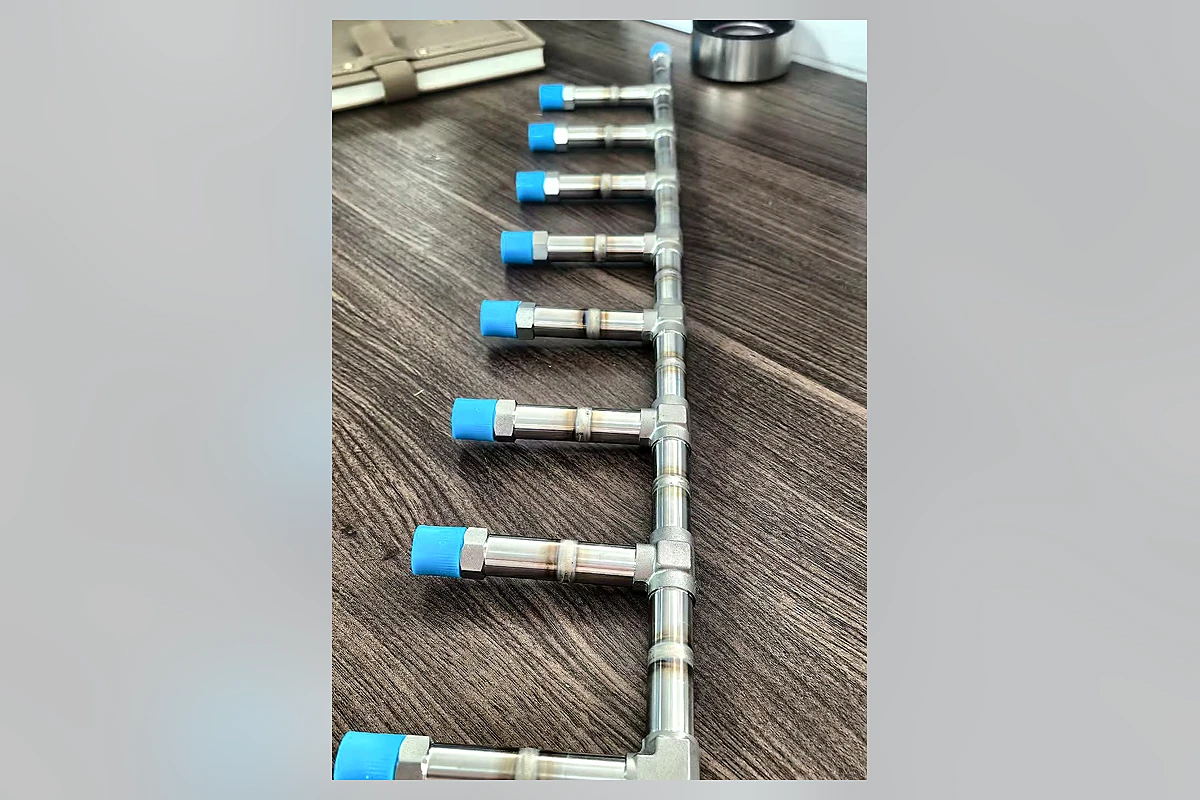
Stainless steel manifold assembly featuring multiple welded branch connections.
This is one of the most common misconceptions in welding automation.
Many manufacturers assume that industrial robots are naturally better for high-mix, low-volume production, while dedicated welding equipment is suitable only for high-volume production of a single product.
For applications primarily involving circumferential pipe welding, this assumption is not necessarily correct.
Dedicated Pipe Welding Systems: Suitable for Both High-Volume Production and Frequent Changeovers
Dedicated pipe welding systems can be designed with adjustable clamping mechanisms, chucks, support structures, and programmable welding parameters to accommodate a range of pipe diameters, wall thicknesses, and joint configurations.
For many conventional circumferential pipe welding applications, manufacturers do not need to design a separate dedicated fixture for every pipe diameter. Nor do they necessarily need the extensive motion reprogramming associated with changing complex robotic welding paths.
When switching between product specifications, operators can often adjust the clamping position and mechanical supports, then select or modify the appropriate welding program.
This makes dedicated pipe welding systems a practical and potentially cost-effective solution for manufacturers whose production requirements include:
- Multiple pipe sizes but similar welding operations.
- Frequent changes in pipe diameter and wall thickness while maintaining the same basic circumferential welding process.
- Small order quantities for individual product specifications.
- A need to reduce changeover time, programming effort, and operator skill requirements.
- Repeatable welding procedures across different product specifications.
For these production environments, the key consideration is not simply the batch size. It is whether different products can be processed on the same mechanical platform and welding control system with straightforward adjustments.
For manufacturers handling different pipe sizes and joint configurations, MECANEXT offers a range of pipe and fitting automatic welding machines designed for various circumferential welding applications.
Industrial Welding Robots: Better Suited to Complex Paths and Diverse Welding Tasks
The primary advantage of industrial robots is not simply their ability to handle more pipe diameters. It is their ability to change torch position, orientation, and travel path across multiple axes.
When workpieces contain welds in different directions, complex intersecting joints, or multiple welding positions, robots provide greater freedom of movement.
However, this flexibility also introduces additional system requirements.
Depending on the application, robotic welding may require product-specific positioning fixtures, custom tooling, workpiece positioners, sensors, or seam tracking systems. Different products may also require new robot programs, adjustments to the tooling, and renewed welding procedure validation.
Therefore, a greater number of product specifications does not automatically make robotic welding the better choice. If the products share similar joint configurations and welding paths, the additional motion flexibility of a robot may not translate into meaningful production benefits.
How Should You Make the Decision?
For applications primarily involving conventional circumferential pipe welds, dedicated pipe welding systems should be evaluated first—whether production is high-volume or high-mix, low-volume.
For workpieces involving complex three-dimensional paths, multi-directional welds, or several different welding operations, industrial robots or specially engineered welding systems may be more appropriate.
Choose the welding solution according to joint configuration, workpiece geometry, and changeover requirements—not simply according to batch size.
For a more detailed equipment selection process, read our guide on how to choose the best automatic pipe welding machine, covering rotary welding centers, orbital welding systems, and different pipe fabrication requirements.
Conclusion: Choose the Right Welding Process, Not Just the Technology
Industrial welding robots and dedicated pipe welding systems each offer distinct advantages. Neither technology is the best solution for every pipe welding application.
For manufacturers focused on circumferential pipe welding, consistent weld quality, and straightforward product changeovers, dedicated pipe welding systems are often worth evaluating first. Whether production involves large batches of standardized components or high-mix, low-volume orders, a dedicated system can provide a practical and economical automation solution when joint configurations are clearly defined and product dimensions fall within its operating range.
For workpieces requiring complex three-dimensional welding paths, multi-directional welds, or multiple integrated welding operations, industrial robots may offer greater value.
Before making a purchasing decision, conduct welding trials with actual workpieces. Verify weld quality, production cycle time, changeover time, and process repeatability. Also consider the complete investment, including equipment, tooling, programming, maintenance, and weld repair costs.
Do not compare equipment prices alone or rely solely on demonstration videos. The right pipe welding automation solution is the one that consistently produces acceptable welds and meets your actual production requirements.
At MECANEXT, we provide industrial welding automation equipment and customized welding solutions for a wide range of manufacturing applications.
From circumferential pipe welding and hydraulic tube assemblies to pressure piping fabrication and complex pipe components, our approach starts with your workpiece geometry, welding process, and production objectives.
Looking for the right automated pipe welding solution for your application? Contact MECANEXT to discuss your requirements and explore a welding system designed around your production needs.
Need Help Choosing a Pipe Welding System?
Not sure which welding system fits your application? Tell us about your workpiece or production challenges. Drawings and photos are welcome but not required. Contact MECANEXT to explore a suitable welding solution.