
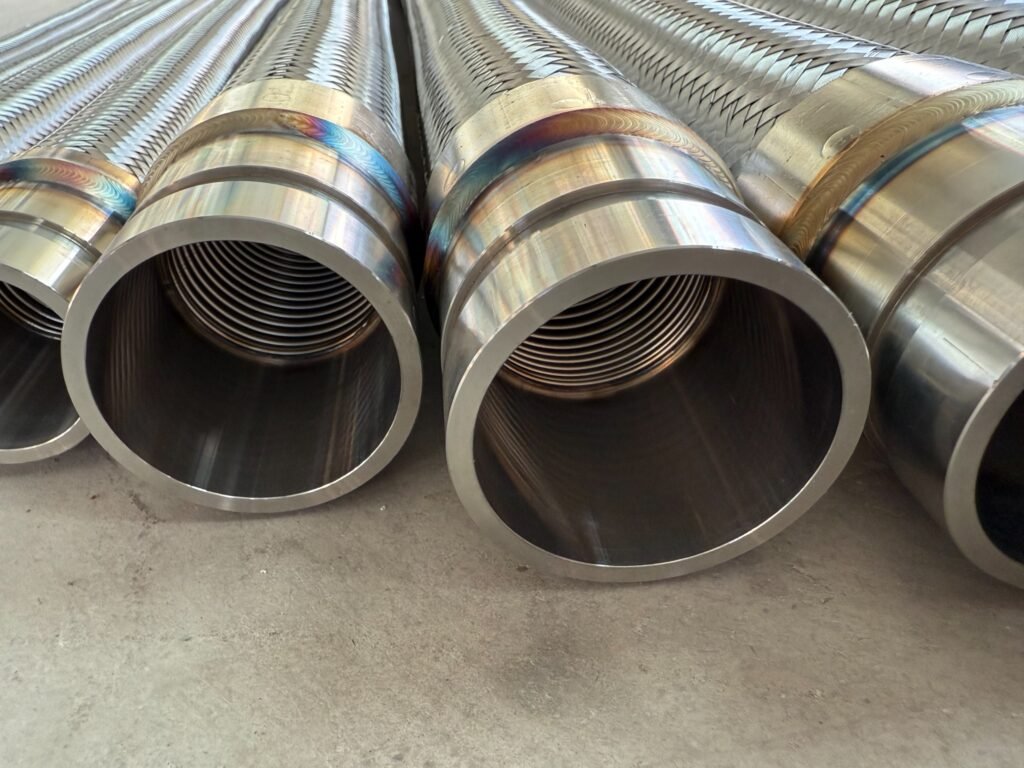
Automatic metal hose welding has become the preferred solution for producing stainless steel metal hose assemblies. It is particularly suitable for high-volume production and applications requiring consistent, high-quality welds.
Manual welding remains essential for customized or low-volume products, while automatic welding delivers superior efficiency, repeatability, and product consistency. Together, these two manufacturing methods complement each other and continuously improve productivity and quality throughout the flexible hose industry.
Three Common Automatic Welding Processes for Metal Hose Assemblies
Automatic welding for metal hose assemblies generally falls into three categories:
1.Cap Welding + Fitting Welding (Two-Step Welding)
2.One-Shot Welding (Single-Pass Welding)
3.Secondary Welding (First weld between corrugated hose and fitting, followed by a second welding operation for the remaining components)
Among these methods, One-Shot Welding offers the highest production efficiency and has become increasingly popular among professional metal hose manufacturers worldwide.
What is One-Shot Welding?
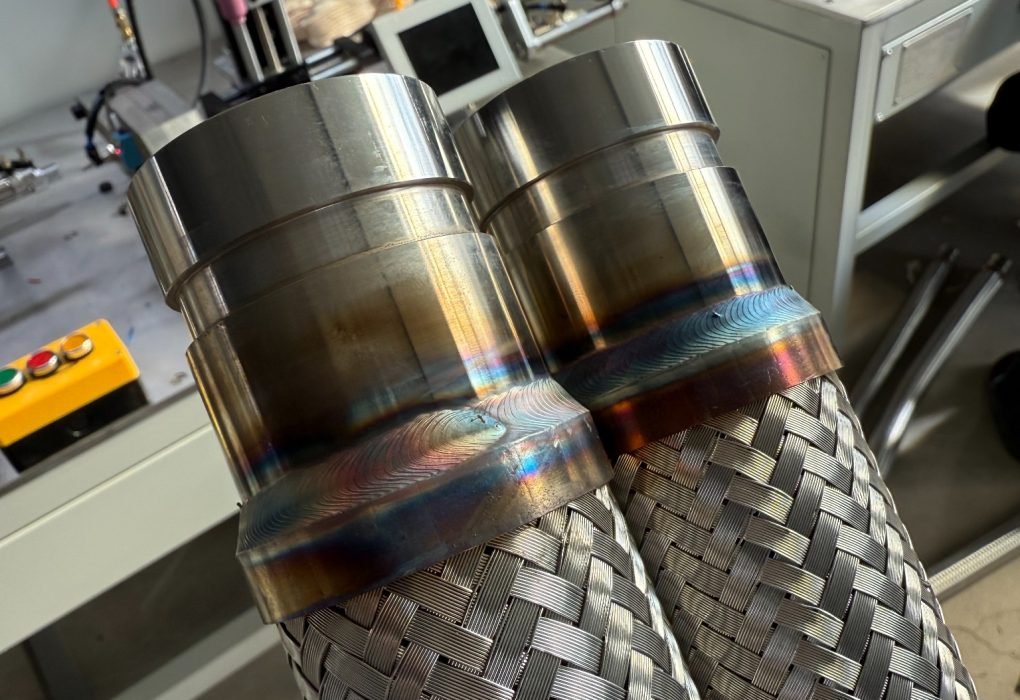
One-Shot Welding is an automatic TIG welding process that completes the entire hose assembly in a single welding cycle.
To ensure consistent welding quality, semi-finished hose assemblies undergo a series of standardized pre-processing operations before welding. These preparations guarantee excellent dimensional consistency and allow the welding process to be fully automated.
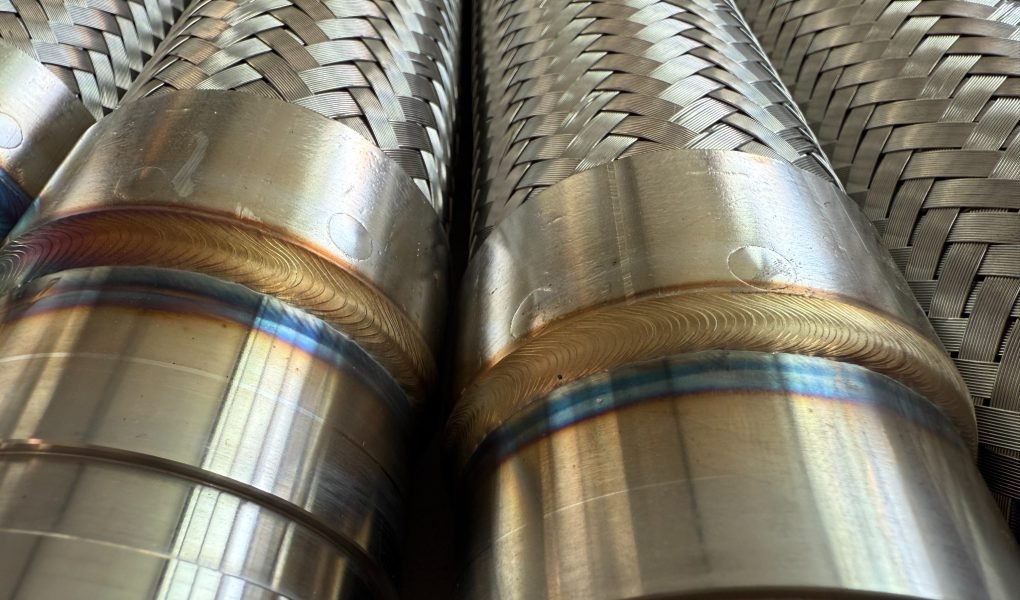
Using MecaNext‘s proprietary welding process, manufacturers can achieve:
- More than 98% first-pass yield
- Oxide-free internal welds
- Smooth and uniform weld appearance
- Excellent repeatability from part to part
- No skilled welder required during production
The operator is only responsible for loading and unloading the workpiece, while the complete welding cycle is performed automatically.
Typical Applications
One-Shot Welding is ideal for:
- High-volume metal hose production
- Products requiring premium weld quality
- Oxidation-free internal surfaces
- Stainless steel flexible hose assemblies with customized fittings
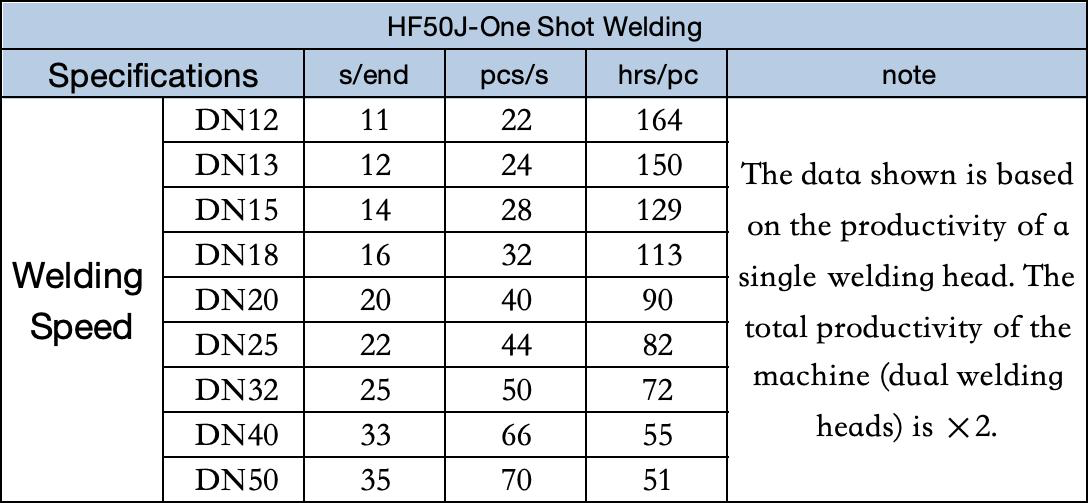
High Productivity
Compared with manual TIG welding, One-Shot Welding significantly reduces production time while maintaining consistent weld quality.
Wide Size Range
Suitable for hose sizes from:
DN6 – DN50
Advantages of One-Shot Automatic TIG Welding
- Full penetration
- Uniform weld appearance
- Oxidation-free internal surface
- Stable welding parameters
- High process repeatability
Pre-Processing Steps
Proper pre-processing is essential for achieving high welding consistency.
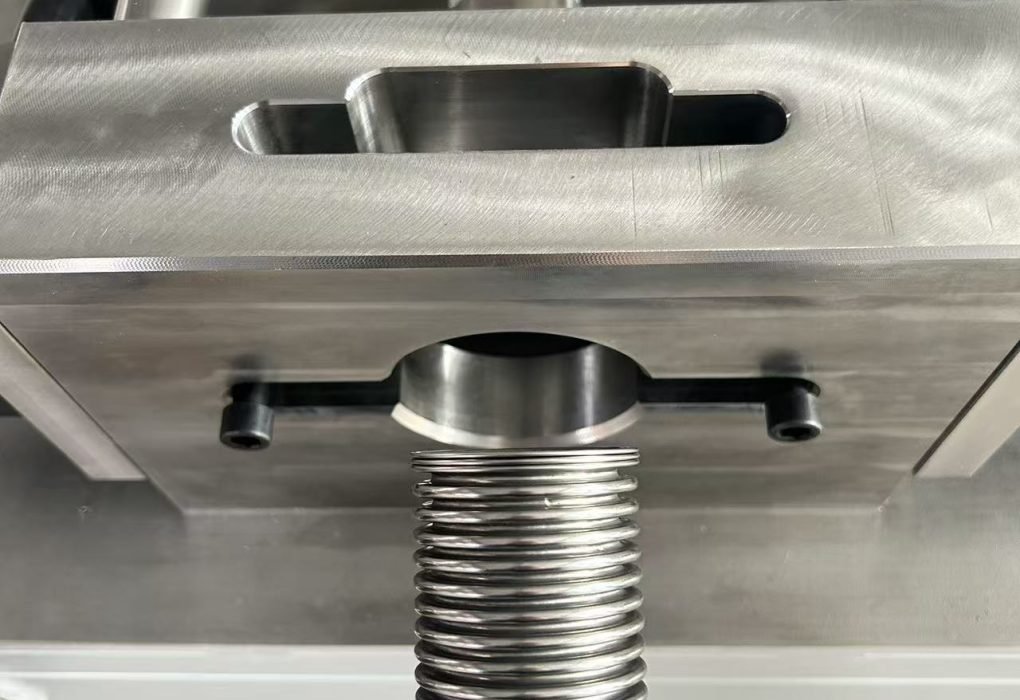
1. Corrugation Flattening
The first three corrugations at the end of the hose are flattened to reduce the gap between the corrugated hose and the fitting. Flattening multiple corrugations significantly improves welding consistency and first-pass yield.
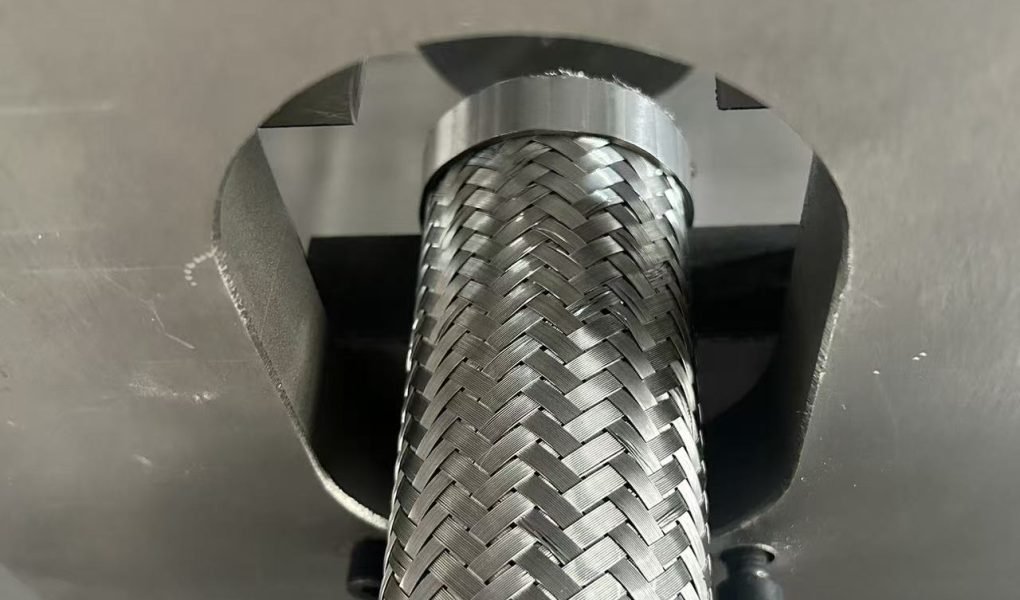
2. End Face Compression
The corrugated hose, braid, and neck ring are compressed into the same plane to ensure precise positioning before welding.
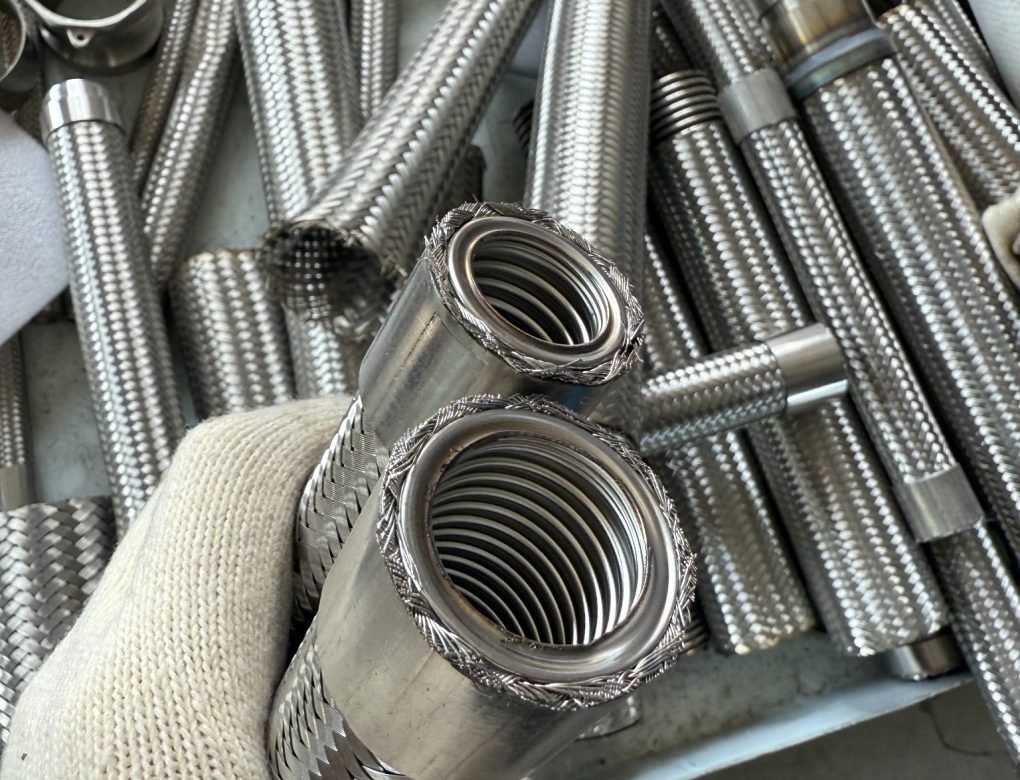
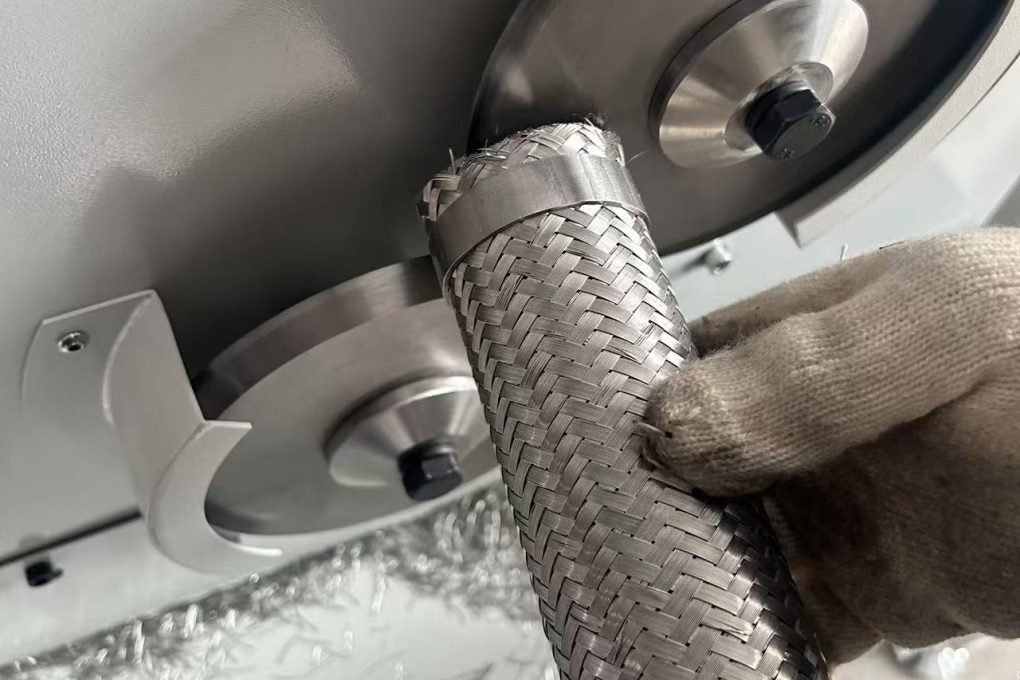
3. Braid Trimming Excess
stainless steel braid is trimmed to prepare the hose end for automatic welding.
4. Automatic TIG Welding
Why Manufacturers Choose Automatic Metal Hose Welding?
If your goal is to maximize production efficiency while achieving premium welding quality for stainless steel flexible hose assemblies, One-Shot Welding is the ideal solution.
MecaNext provides complete automatic TIG welding solutions for metal hose manufacturers, helping customers improve productivity, reduce labor dependency, and achieve highly consistent weld quality for batch production.
Contact MecaNext to learn more about our automatic metal hose welding solutions.
Frequently Asked Questions (FAQ)
Q1. What is automatic metal hose welding?
Automatic metal hose welding is an automated TIG welding process that joins stainless steel corrugated hoses and fittings with high precision. It provides consistent weld quality, high productivity, and minimal operator intervention.
Q2. What is One-Shot welding?
One-Shot welding is a single-pass automatic TIG welding process that completes the entire hose assembly in one welding cycle after standardized pre-processing. It improves efficiency and ensures consistent weld quality.
Q3. Why is pre-processing necessary before welding?
Pre-processing—including corrugation flattening, end face compression, and braid trimming—ensures accurate positioning, reduces fitting gaps, and significantly improves first-pass welding yield.
Q4. Can automatic TIG welding replace manual welding?
Automatic TIG welding is ideal for high-volume production requiring stable quality and repeatability, while manual welding remains better suited for customized or low-volume products. Both processes complement each other in modern manufacturing.
Q5. Which industries use automatic metal hose welding?
Automatic metal hose welding is widely used in industries such as petrochemical processing, semiconductor manufacturing, food and beverage, pharmaceuticals, vacuum systems, hydrogen energy, LNG, and other applications requiring high-quality stainless steel flexible hose assemblies.