Loading arms are industrial valves used to safely transfer flammable or hazardous liquids and gases. This equipment is an integral part of the oil, gas, concrete, and manufacturing industries. In the event of a breakdown, no facility can afford the loss of revenue. The quality of a loading arm depends directly on the quality of its welds.


The standard for manufacturing has to be very high. Among the new loading arm manufacturing automation trends, one method truly stands out. Automatic TIG (Tungsten Inert Gas) welding is the way to go if you want to make durable loading arms. This article makes it clear that this technology is the definitive solution for solving modern manufacturing problems.
Loading Arm Manufacturing: The Problems of Today
Makers of loading arms face several tough, contemporary problems. These issues directly affect production targets and can lead to safety issues. Understanding these problems shows why a change is needed.
Correct Welds as a Priority
Welds on a loading arm are typically under high pressure. A tiny flaw can cause a dangerous leak of toxic substances. It can also jeopardize expensive products. For this reason, it is essential that every single weld be completely flawless. This demand for perfection greatly increases the difficulty of the manufacturing process.
More and More Complex Materials
Modern loading arms are not just made of simple steel. They increasingly use advanced materials like stainless steel, aluminum, and other special alloys. These materials are rust-resistant and wear-resistant, but they are much harder to weld correctly. They require very specific techniques and precise control that manual welding struggles to provide.
The Shortage of Skilled Welders and Variability Issues
Finding and retaining certified welders is more challenging than ever. The American Welding Society projects a shortage of several hundred thousand welders in the coming years. This shortage leads to production delays and affects the final product’s quality. Reliance on manual welding means quality can vary from one worker to another, and even from the start of a shift to the end.
Importing the Automation: Gantry Program Revamped
Automation is the solution to these difficulties. Automation has revolutionized the manufacturing sector, and loading arms are no exception. Current automation techniques in loading arm manufacturing involve using robots for material handling and machines for quality checking.
The most crucial development is automated welding. It directly addresses the biggest problems: quality, consistency, and the labor shortage. By using machines for welding, manufacturers can achieve perfect results every time. To learn more, it is helpful to review an overview of Understanding Automated Welding and Future Trends.
What Makes Automatic TIG Welding the Optimum Choice for Loading Arms?
While several automated welding methods are available, automatic TIG welding is the clear winner for loading arms. Its unique benefits perfectly satisfy the high-demand requirements of this product. Let’s explore the reasons why this specific process is the superior choice.
Zero Error on Joints Subject to Strain
Loading arms have many complex joints, such as where a pipe meets a flange or at a swivel point. The TIG process uses a very focused and stable electric arc, giving the system incredible control. Automatic TIG ensures the weld fully melts and joins the metal parts, creating a strong, solid connection that can withstand high stress and pressure. This precision is essential for safety.
Uniformity of Weld Purity and Appearance (No Spatter)
A key advantage of TIG welding is that it creates no spatter. Spatter is the small drops of metal that fly out during other welding processes. This isn’t just about making the weld look clean.
For loading arms used in the food, beverage, or drug industries, the inside of the pipe must be perfectly smooth. Spatter creates rough spots where bacteria or pollutants can hide. Because TIG is a spatter-free process, it guarantees internal cleanliness. It also saves a huge amount of time and money by eliminating the need for post-weld grinding and cleaning.
Excellent Control and Consistency to Circular Parts
Loading arms are mostly made of pipes and tubes. Welding around a cylinder by hand while keeping the quality perfect is extremely difficult. This is where a special form of TIG shines.
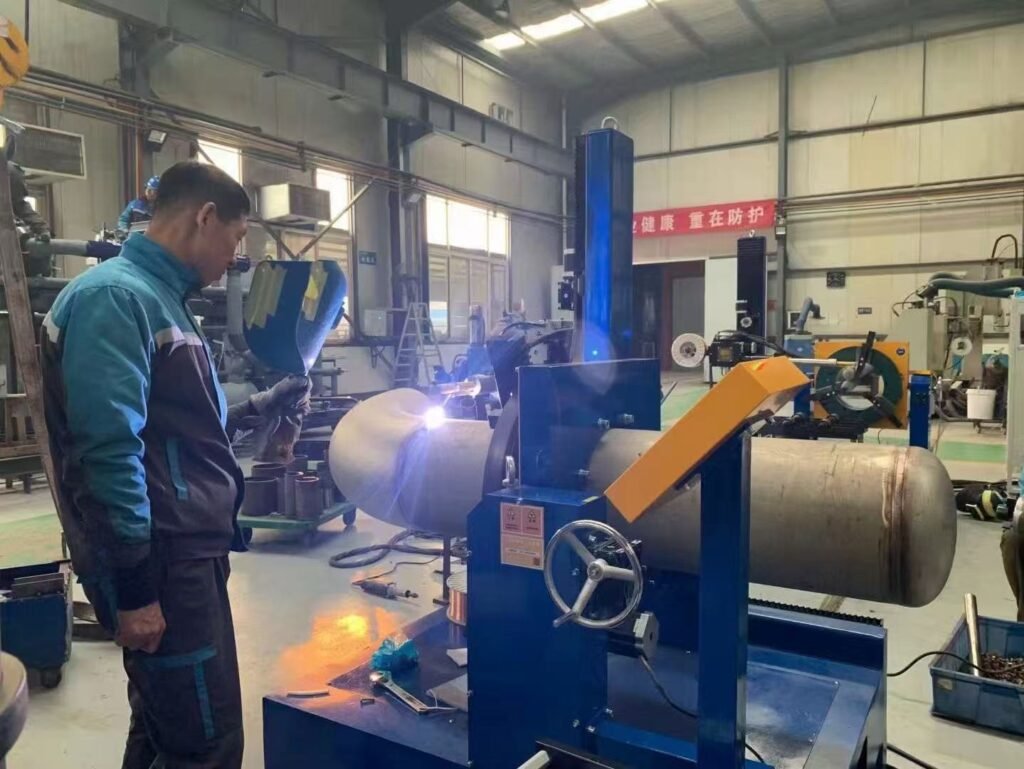
Systems that use automated orbital TIG welding are designed for this exact task. A weld head rotates, or orbits, around the pipe, creating a flawless, 360-degree weld every single time. This level of repeatability is impossible to achieve manually and ensures every loading arm meets the same high standard.
Adaptability with the Most Advanced Materials
As mentioned, loading arms now use tougher materials. Automatic TIG welding is excellent at joining these high-spec metals. It works perfectly with the 304 and 316 stainless steel grades common in the industry. It also produces strong, clean welds on aluminum and other alloys, making it a flexible solution for any loading arm design.
TIG vs. MIG Welding: A Head-to-Head Comparison for Loading Arm Manufacturing
When discussing automated welding, managers often ask about TIG versus MIG (Metal Inert Gas) welding. MIG is known for being faster, but for a high-stakes product like a loading arm, speed is not the most important factor—quality and reliability are.
This table compares the two methods specifically for loading arm production. It shows why automation trends in loading arm manufacturing clearly favor automatic TIG welding.


| Feature | Automated TIG | Automated MIG |
|---|---|---|
| Weld Quality & Purity | Highest purity, x-ray quality welds. No impurities. | Good quality, but a higher risk of defects like porosity. |
| Spatter Level | None. The weld is perfectly clean. | High. Creates spatter that must be cleaned off. |
| Heat Input Control | Excellent. Low and precise heat prevents warping. | High heat input. Can distort or warp thinner materials. |
| Suitability for Thin Materials | Ideal. Can weld thin-wall pipes and tubes easily. | Challenging. Risk of burning through thin metals. |
| Post-Weld Cleanup | Minimal to none. Ready for use almost immediately. | Extensive. Requires grinding and cleaning to remove spatter. |
| Best for Pressure-Tight Welds | The definitive choice for 100% leak-proof welds. | Capable, but requires more inspection to ensure no leaks. |
The answer is evident. For the safety-critical, high-purity needs of loading arms, automatic TIG welding is the best practice.
Incorporating Automated TIG in Your Loading Arm Production Line
Moving to automated TIG welding is a strategic project that transforms your production line from a manual process to a high-tech operation. Here is a practical roadmap based on our experience helping manufacturers make this change.
Step 1: Application and Weld Joint Analysis
First, look closely at your loading arm designs. Identify every weld joint, noting the material, thickness, and joint type (e.g., pipe-to-pipe, pipe-to-flange). This analysis will determine the exact type of equipment and programming you need.
Step 2: Robo Cell Fitting for TIG Machine
A robotic welding cell is a system of components that work together. A typical setup for Robotic TIG Welding includes several key pieces of equipment.
- 6-Axis Robotic Arm: It facilitates all the weld joints.
- Advanced TIG Welding Power Source: The “brain” that controls the electrical arc.
- Orbital Weld Heads: Specialized tools for perfect welds on pipes and tubes.
- Part Positioners and Turntables: Fixtures that hold and rotate the loading arm sections into place for the robot.
- Fume Extraction System: A critical safety feature to remove harmful fumes.
- Safety Guarding: Physical barriers and sensors to protect workers from the moving robot.
Together, these parts work as a team to deliver the perfect weld every time. The correct combination is the key to victory.
Step 3: Programming, Fixturing, and Operator Training
Success is not just about the robot; it also depends on precise programming to guide the torch and strong fixtures that hold the loading arm parts in the exact same position for every cycle.
Finally, your team is your most vital asset. Your existing welders are the perfect people to train as robot operators. Their knowledge of welding is vital for fine-tuning programs and solving problems. This is not about replacing workers; it is about giving them more powerful tools.
Partnering for Your Success
For a complex project like this, you do not have to go it alone. Partnering with an experienced automation integrator is crucial for a smooth transition. Companies like Mecanext specialize in designing and deploying custom solutions for industrial manufacturing. An expert partner can help you avoid common pitfalls and get your system running faster.
Conclusion: The Future of Loading Arm Manufacturing is Automated and Precise
The challenges in making loading arms are on the rise. The need for perfect quality, the use of complex materials, and a shortage of skilled labor call for a new approach. The latest automation trends in the loading arm manufacturing sector point to a clear solution.
Automatic TIG welding delivers unmatched quality, purity, and consistency. It eliminates human error and costly rework. By embracing this technique, manufacturers can boost safety, increase production, and secure long-term profitability. Choosing automatic TIG welding is more than an upgrade; it is a strategic investment in the future of your company.
Frequently Asked Questions (FAQ)
Q1: How much is the average ROI for an automated TIG welding system in loading arm manufacturing?
While the initial investment is significant, the return on investment (ROI) is often seen within 18 to 36 months. This comes from lower labor costs, almost zero defects (which means less scrap and rework), and higher production rates. The primary financial benefit, however, comes from avoiding costly field failures related to bad welds.
Q2: Is automated TIG welding significantly slower than automated MIG?
Yes, the TIG process itself has a slower travel speed than MIG. However, for loading arm production, this is balanced out. TIG welding requires no time for post-weld grinding or spatter cleanup, which is a major step with MIG. The total “weld-to-finish” cycle time is often much more competitive than it first appears.
Q3: Can we retrain our current welder operators to run these robotic systems?
Absolutely. Skilled welders are the best candidates to become robot operators and programmers. Their deep understanding of how welding works is extremely valuable for optimizing the robot’s programs and troubleshooting any issues. This transition upskills your workforce, making your team more valuable.
Q4: What are the main safety concerns when implementing robotic welding?
The top priority is creating a safe work area around the robot. This involves physical safety fences, light curtains (which stop the robot if a beam is broken), and safety interlocks on all doors. Proper ventilation to remove welding fumes and protection from the bright arc are also mandatory safety measures.
Q5: Does TIG welding work for the repair of loading arms or is it only for new manufacturing?
Its main strength is in new manufacturing, where it can repeat the same perfect weld thousands of times. However, automated systems can be programmed for specific, standard repair jobs. For unique, complex repairs done in the field, a skilled manual welder is usually still the best option.